

From the team: How the revised Urban Wastewater Treatment Directive is driving tougher stormwater regulations
A wave of new rules is about to hit Europe’s wastewater systems, bringing with it stricter regulations for urban runoff.
The EU’s revised Urban Wastewater Treatment Directive (UWWTD) aims to deliver €6.6 billion in economic benefits per year by 2045. It plans to do this by implementing stricter water treatment standards to improve water quality and by firmly enforcing the “polluter pays” principle.
But is France ready for the new regulations? First, let’s look at what’s changing.
The revised directive
Under the new directive, wastewater must be collected and treated in every urban area with more than 1,000 inhabitants, as opposed to 2,000 before.
Micropollutants including PFAS and microplastics will also need to be monitored and treated for the first time, with a roadmap setting out how wastewater treatment plants need to address these by 2045.
Crucially, stormwater is recognised in the revised directive as a significant cause of water pollution, meaning urban areas will need to invest in infrastructure to effectively manage and treat this.
In France, the revised directive will become law by July 2027. With these stricter regulations just over a year away, water companies and municipalities need to act now to make sure their systems are compliant.
Where is France now?
After several summer droughts and rising water scarcity concerns, water infrastructure has without a doubt become part of the public and political debate in France.
In 2023, President Macron’s Plan Eau signalled to the country that water is an essential and limited resource that must be protected. With climate change projected to reduce available water in France by 30 to 40 percent by 2050, Plan Eau set out to prevent water scarcity by upgrading infrastructure and recycling 10% of treated wastewater by 2030.
Despite this, the issue of water pollution and particularly stormwater has flown under the radar for years. Many municipalities simply feel that competing financial resources are better spent on other public infrastructure including schools and transport systems.
It doesn’t help that stormwater pollution is something of an invisible challenge.
Rainwater washing into waterways from roads and rooftops collects pollutants from a range of diffuse sources, creating a cocktail of sediment, plastics, hydrocarbons and heavy metals, as well as nutrients such as nitrogen and phosphorus from fertilisers and organic waste.
These pollutants are not visible to the naked eye but can damage water quality, harm aquatic habitats and contribute to algal blooms that affect public health. And yet, dissolved in rainwater, these pollutants are often discharged not into treatment systems but directly into local streams and rivers.
Tackling the stormwater problem
Effective stormwater treatment is complicated by the fact that rainfall is highly unpredictable, made even more so by our changing climate.
With extreme weather events becoming more common, stormwater treatment devices must be capable of handling variable and intense peak flows without overflowing into urban catchments.
Installing these devices also presents a logistical challenge. High-density urban areas often have limited space available to retrofit stormwater treatment systems that weren’t factored into planning at the time.
Then there’s the matter of maintenance. Hidden underground, it’s all too easy to forget about them but, as with any asset, stormwater treatment systems can’t function properly if they aren’t subjected to regular monitoring, part replacement and repairs as needed.
Simplifying stormwater treatment
Hydro International’s Downstream Defender® Select (DDSelect®) has been designed to address all of these challenges and make stormwater treatment easier to manage.
An industry-leading hydrodynamic vortex separator, the DDSelect® is a flow-tolerant system capable of removing pollutants and sediments at volume and across a wide range of flows.
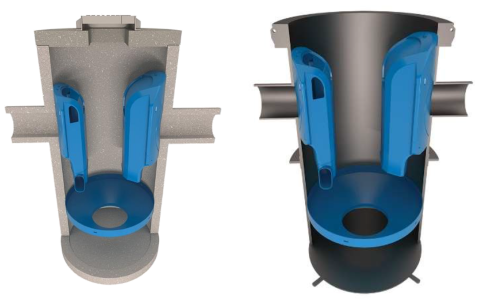
It can be customised to meet specific stormwater quality objectives and is available in different shapes, sizes and materials including concrete and plastic. It also has a compact footprint and can be connected to up to three inlets, making it extremely easy and quick to install.
To make maintenance simpler and more cost-effective, the DDSelect® can be configured with Hydro-Logic® Smart Maintenance, a smart monitoring hard- and software that sends automated maintenance alerts. This ensures the system continues to perform as it should without the need for time-intensive inspections.
This system has already been selected by many municipalities and installed on projects across the country and the world to improve water quality and protect the environment from stormwater pollution.
In France, the DDSelect® is available immediately, in concrete or high-density polyethylene (PEHD) chambers to accommodate clients’ specific needs and project constraints.
Stormwater pollution is no longer something we can ignore. The revised UWWTD offers an opportunity for municipalities, developers and utilities to help make France’s towns and cities more resilient.
We already know that water is a precious resource but we now need to take the necessary steps to manage and treat stormwater to protect our waterways and the communities relying on them.
By Mathieu Jequece, Business Development Manager

Recent case study
To see how the DDSelect® has already delivered high-performance stormwater treatment, read about our recent project in Valenciennes Métropole in France.